Temporary and agency workers: how to manage continuous onboarding
Why hiring temporary workers is becoming unavoidable, and how companies can structure continuous onboarding with practical, visual instructions.
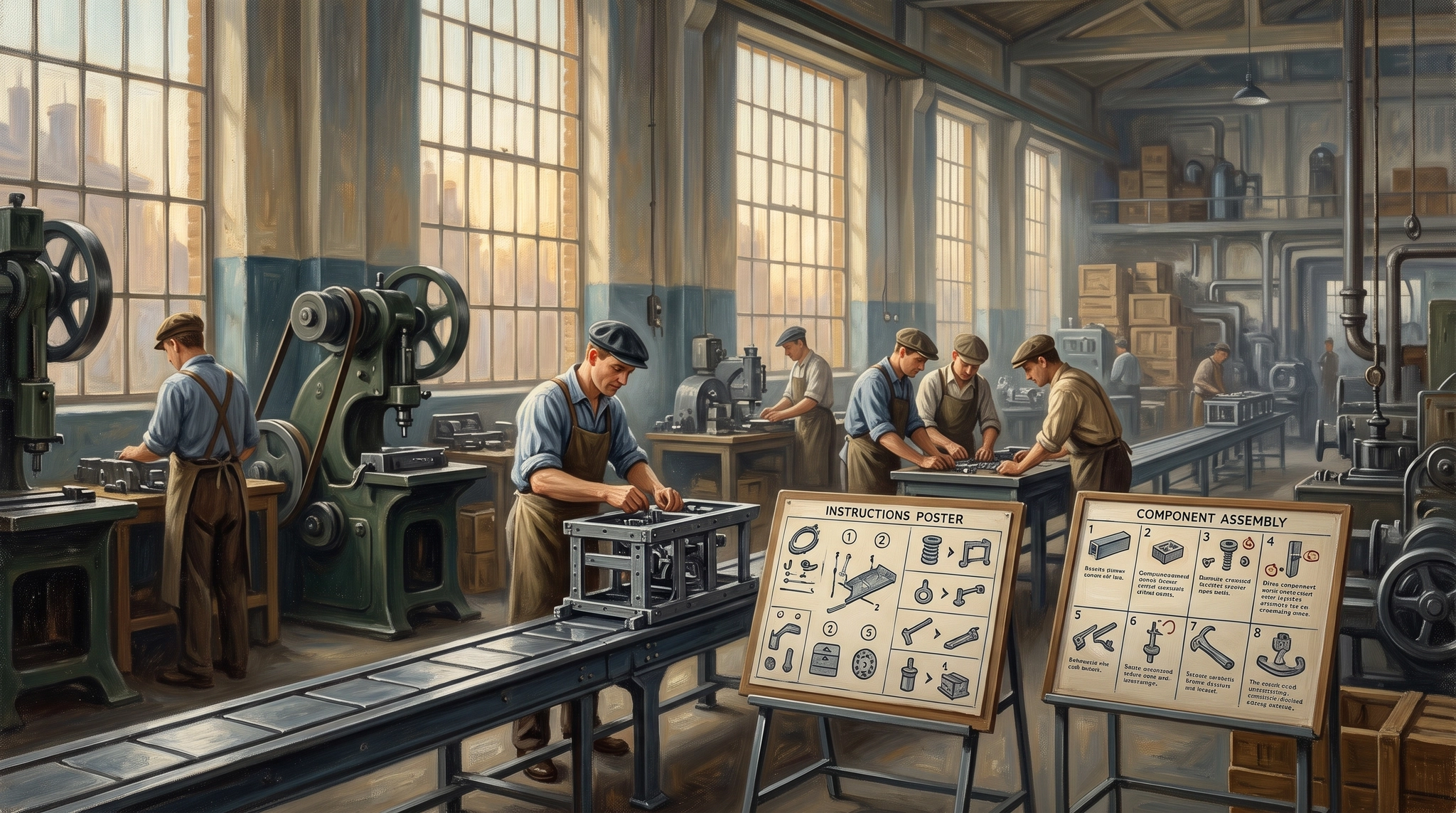
Repeatable onboarding for temporary workers begins when a company stops relying on someone to “explain it on the shift” and starts treating operational knowledge as part of the process. Not as a document in a binder. As a standard available at the workstation, at the moment the work is being done.
Because agency workers are no longer a backup plan. In many plants, they are a permanent part of how production flexes: when a larger order comes in, when an extra shift needs to be opened, when people are missing, when the season will not wait for recruitment.
The problem is not that people come from an agency. The problem starts when every new person means the same chaos from the beginning.
Why have temporary workers become part of agile manufacturing?
Imagine Monday morning.
On Friday, the plan looked stable. Over the weekend, an urgent order comes in. One person calls in sick, two others are on vacation, the agency sends three new workers, and the shift manager has a few hours to maintain takt time, quality, and safety.
On paper, everything adds up. There are people. There is a plan. There is a procedure.
On the shop floor, the real test begins.
Who will show the new people where the workstation is? Who will explain what not to touch? Who will show the difference between a part assembled correctly and one that “almost looks right”? Who will answer questions when the team leader is already dealing with the next problem?
This is daily reality for many companies. Agile manufacturing does not only mean faster production planning. It means the ability to move people quickly, start up workstations, and maintain the standard despite a changing team composition.
In other words: production can only flex when knowledge flexes with it.
Why can’t this trend simply be stopped?
Temporary and agency workers are a response to real operational pressure, not an HR fashion.
Most often, very concrete reasons are behind it:
- seasonality of orders,
- sudden volume increases,
- absences and vacations,
- difficulty recruiting permanent employees,
- short runs and special projects,
- cost pressure,
- the need to scale shifts quickly,
- increasing demand unpredictability.
The permanent team is the foundation. But the permanent team alone is increasingly not enough to handle a reality in which orders change faster than the recruitment process.
A company can, of course, complain about turnover. Or it can treat turnover as a system parameter and design the process so that it works despite turnover.
The second approach wins.
How big is this issue in the numbers?
In Poland, Eurostat shows a low share of agency work in total employment, around 0.5%, but industry reports show a very different picture in operations: according to the Polish HR Forum and Tikrow’s report, demand for casual workers in retail, manufacturing, and logistics has remained at around 70% since the second quarter of 2025, and in the first quarter of 2025, 72% of manufacturing companies and 62% of logistics companies planned to hire temporary workers.Polish HR Forum Staffing Industry Analysts
In practice, this means the question is not: “What is the average share of agency workers in the economy?” For a plant manager, another question matters more: “What share of these workers may appear on my shift, in my industry, during a week of increased volume?”
That is why internal benchmarks for plants with 50+ employees should be read operationally, not statistically. The share of agency workers may range from 5–15% in food and pharma to 30–40% in automotive or logistics. These figures are not meant to replace official public statistics. They are a practical picture of the pressure visible on the shop floor: the greater the volume variability and the greater the need to scale shifts quickly, the more onboarding becomes a continuous process.
Where is the real cost of turnover hidden?
The cost of a temporary worker is easy to calculate in the hourly rate. It is harder to calculate the cost of dozens of small interruptions, questions, corrections, and improvised training sessions that appear around that person.
And that is exactly where margin leaks away.
The shift leader shows the same task for the third time in a week. An experienced operator interrupts their own work to correct a new person’s mistake. A technician explains an exception that is not in the instruction. Quality control detects a problem that did not come from a lack of willingness, but from a lack of a clear reference.
Knowledge exists, but it is not a system. It is scattered across people’s heads.
That is the difference between a company that has procedures and a company that has a work standard.
A procedure can be in a file. A standard must be at the workstation.
Why doesn’t classic onboarding work for agency workers?
Classic onboarding assumes time.
The first day, general training, a site tour, documents, workstation onboarding, a few days of observation, gradually becoming independent.
In the agency model, this rhythm often falls apart. A new person has to step in quickly. Sometimes for a simple operation. Sometimes for a night shift. Sometimes at a workstation where every mistake costs more than the onboarding itself.
That is why onboarding temporary workers has to be different.
It has to be:
- short,
- practical,
- visual,
- workstation-specific,
- available at the moment of work,
- resilient to language differences,
- repeatable across shifts,
- independent of who happens to have time to explain.
The point is not to transfer all the company’s knowledge to a new person. The point is for that person to receive, at a given moment, exactly the knowledge they need to perform the task correctly and safely.
What most often breaks continuous onboarding?
In plants, the same problems repeat with surprising similarity.
The first problem: knowledge is oral. The best operator knows how to do something, but cannot quickly transfer it to ten new people in a month. Or can do it, but at the cost of their own work.
The second problem: documentation is too heavy. The instruction exists, but it has a dozen pages, is written in audit language, and sits somewhere no one uses it during work.
The third problem: each shift has its own version of the truth. One person shows it one way, another slightly differently, a third says: “This is how we do it here.” All variants may work. Not all of them produce the same result.
The fourth problem: onboarding ends too early. Formally, the worker has been trained. In practice, they still do not know what to do when a part looks unusual, the machine behaves differently, or the sequence of steps does not fit the situation on the floor.
These are not HR problems. They are operational problems.
How can onboarding be standardized without burying people in paper?
Not by creating a huge training program. By starting with one workstation.
The best place to choose is one where new people often appear, where questions to the team leader are frequent, or where quality corrections happen. Then you need to do something simple: capture the way the best person works and turn it into an instruction that can be repeated without that person’s constant presence.
A good instruction for a temporary worker does not describe the world. It guides the person through the task.
It shows:
- what to do first,
- where to look,
- what not to confuse,
- what the correct result looks like,
- when to stop work and ask,
- which mistakes happen most often.
The format matters most. A photo, a short video, a marker, or a “right / wrong” example often does more than a paragraph of text. Especially when people have different experience, different languages, and different levels of confidence on their first shift.
A description says what should happen. A demonstration shows what well-done work looks like.
How can you measure whether onboarding really works?
If onboarding works, it should be visible in the numbers.
You do not need to start with a complicated system. Four indicators are enough:
- Time to independence. How many days or shifts pass before a new person works without constant assistance.
- Number of questions to the leader. How often the shift leader has to interrupt work to explain a basic task.
- Corrections and errors. How many operations need to be repeated or corrected after new people are onboarded.
- Variation between shifts. Whether the result depends on who is leading the shift today and who happened to explain the task.
The last point matters most. The average may look good while the process remains fragile. Repeatability means the result stops depending on one specific person on the shop floor.
As long as one shift can onboard new people well while another starts from improvisation every time, the company does not have a standard. It has local talent.
How does Aikando help with continuous onboarding?
Aikando does one thing in this process: it helps turn the knowledge of the best workers into a standard available to everyone.
Instead of keeping know-how in the head of an operator, team leader, or technician, the company can record it as short, visual, step-by-step instructions. Instructions that a new person can launch at the workstation, at the moment of performing the task.
In practice, this means Aikando helps to:
- onboard temporary and agency workers faster,
- reduce repeated questions to shift leaders,
- maintain the same way of working across shifts,
- reduce dependence on a few of the most experienced people,
- transfer knowledge in a form that is easier to understand than classic documents,
- support production flexibility without losing control over the standard.
It does not replace leaders. It removes the most repetitive part of onboarding from their shoulders.
The leader still explains context, reacts to exceptions, and develops people. But they no longer have to explain the same basic sequence of steps for the tenth time this month.
Where should you start?
Not with the whole plant.
Start with one workstation where turnover hurts the most.
Choose a process where agency workers appear often and experienced people lose the most time explaining. Measure how long it takes to reach independence, how many questions go to the leader, and where corrections appear. Then capture the way the best person works and turn it into an instruction available at the workstation.
After a month, compare the numbers.
If onboarding time drops, there are fewer questions, and the result becomes more consistent across shifts, you no longer have an opinion about onboarding. You have proof.
Temporary workers will remain part of industry, because industry has to become more and more flexible. So the question is not whether to use agencies. The question is whether the company can maintain the standard when the team composition changes every week.
Knowledge that stays in the heads of a few people does not scale. Knowledge available at the workstation does.
Book a demo: info@captix.eu