
The Ebbinghaus curve in production: why one training session is not enough
Why operators quickly forget part of the instructions after a single on-the-job training session, and how workplace reminders help reduce errors, rework, and dependence on experts.
In every production hall, there is the same moment.
A new person finishes their on-the-job training. Someone has shown them the process. Someone has walked them through the steps. Someone has explained what to watch out for. For a while, everything looks fine.
The operator nods. The team leader asks, “Clear?”. The answer comes back: “Clear”.
Then normal production begins.
The takt returns to its rhythm. The expert moves on to the next problem. The shift leader answers a phone call. The new person is left alone at the workstation, with what they remember from a short training session, an instruction somewhere nearby, and the pressure not to slow down the line.
And that is exactly when something starts working that does not appear in the training schedule.
Memory.
Not bad will. Not lack of engagement. Not a “weak employee”. Simply the human brain, which starts losing new information very quickly after first contact.
What is the Ebbinghaus forgetting curve?
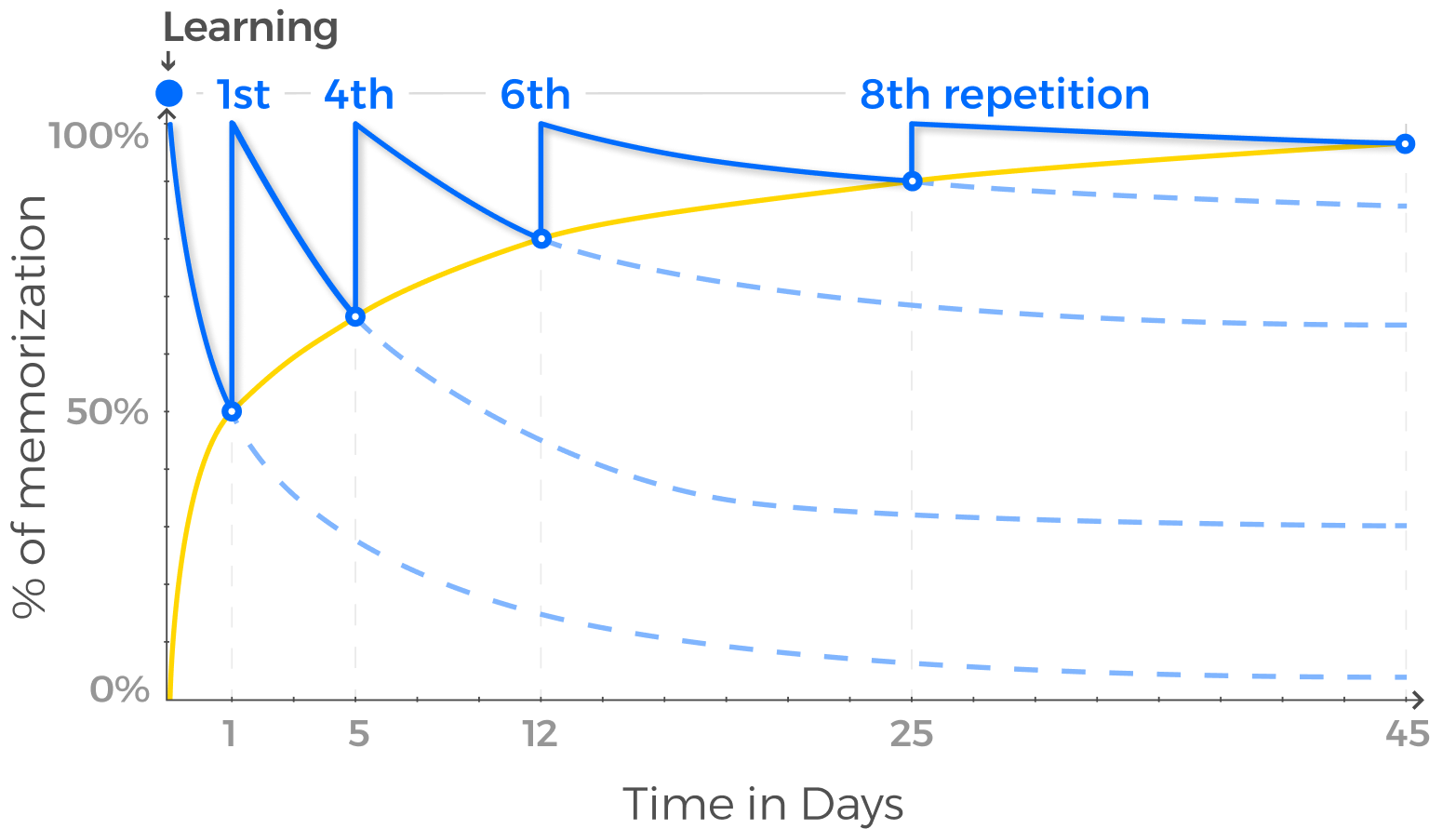
Hermann Ebbinghaus was a German psychologist who, at the end of the 19th century, studied how quickly humans forget newly learned information. The result of his research is known today as the Ebbinghaus forgetting curve.
The mechanism is simple and uncomfortable for anyone responsible for training.
We forget the most immediately after learning. Then the rate of forgetting slows down, but the biggest loss happens very early: in the first hours and days after training.
In L&D materials, a practical benchmark is often cited: without reinforcement, people may forget around 50% of new information within an hour, around 70% within a day, and up to 90% within a week. The exact numbers depend on the type of task, prior experience, stress, and context, but the pattern remains the same: without repetition, new knowledge disappears quickly.Go1 The Learning Guild
In an office, this may mean someone forgets part of a presentation.
In production, it may mean a wrong hand movement, a missed control point, an incorrectly identified part, or a decision made from a memory that is no longer complete.
Why is one on-the-job training session not enough?
Because training and independent work are two different worlds.
During training, someone guides the employee through the process. Shows the sequence. Answers questions. Stops mistakes before they happen. Often, they also simplify the situation without realizing it: choosing a typical example, a calmer pace, and a more predictable moment during the shift.
Then real work begins.
The part is slightly different. The machine sounds different. A colleague nearby asks something at the same time. Takt pressure appears. A quick decision is needed. The instruction is long, and the leader is busy.
That is when the difference appears between “I saw it once” and “I can do it independently”.
One training session gives initial understanding. It does not yet create automaticity, resistance to stress, or memory of exceptions.
In production, the problem is rarely that the employee did not listen. More often, it is that they received too much new information at once, in too little time, without a later reminder at the moment when they truly needed it.
Why don’t experts train the same person five times?
The simplest answer is: because they do not have time.
But that is only part of the truth.
An experienced operator, team leader, or technician is usually not a person “responsible for training”. They are responsible for maintaining results. They have their own tasks, breakdowns, questions from several workstations, plan pressure, and responsibility for quality.
If a new person needs a reminder after an hour, after a shift, and after a week, that is normal from the perspective of memory. From the perspective of work organization, it is sometimes treated as a problem.
“But we already showed this.”
That sentence is dangerous.
The fact that something was shown does not mean it was remembered. And the fact that it was remembered in the morning does not mean it will still be available in the afternoon, with noise, pressure, and an unusual situation.
There are also other reasons why reminders do not work well.
First, people are afraid to ask. A new employee does not want to look like someone who “doesn’t get it”. Sometimes they prefer to guess rather than ask the same question for the third time.
Second, every expert explains things slightly differently. One shows a shortcut. Another emphasizes safety. A third says: “This is how I do it”. Instead of one standard, three different versions appear in people’s memory.
Third, training often ends at the moment of signature, not at the moment of real independence. Formally, the topic is closed. Operationally, it is only beginning.
What research shows: errors in manual assembly and the effect of forgetting
There are two sources in the literature that fit here better than an anonymous “factory case study”.
The first is the study “Quantification of Human Error in Manufacturing: A Case Study in Complex Manual Assembly”, published in Applied Sciences. The authors analyzed human errors in a complex manual assembly process. They showed that operator mistakes can not only be observed, but also classified and measured: from skipping a step, to performing steps in the wrong order, to carrying out an operation incorrectly. This matters because it moves the conversation away from “the employee did not try hard enough” and toward the work system: how well does the process support a person in performing the right action at the right moment?
Further information: Quantification of Human Error in Manufacturing: A Case Study in Complex Manual Assembly
The second source is the paper “Imperfect production process with learning and forgetting effects”. The authors describe a production process in which not only the learning curve is at work, but also the effect of forgetting. In practice, this means that experience improves performance, but breaks, lack of repetition, or insufficient reinforcement of the standard may degrade work quality. The paper’s abstract indicates that product quality may deteriorate as forgetting increases, and that rework is linked to the dynamics of learning and forgetting.
Further information: Imperfect production process with learning and forgetting effects
The conclusion for production is simple: an error after training does not necessarily mean lack of engagement. It may mean that a person is working from incomplete memory, and that the work system does not allow them to return to the standard quickly enough.
This is what the Ebbinghaus curve looks like in practice: not as a chart in a presentation, but as a skipped step, the wrong sequence, a rework loop, or a part coming back from quality control.
What should an agile factory do?
Not assume that a person remembers everything after one demonstration.
That assumption is convenient for the production plan, but it does not match how memory works.
An agile factory should treat reminders as part of the standard, not as an operator’s failure. Just as quality control is not an insult to the operator, returning to the instruction should not be seen as a sign of weakness.
An employee who checks a step before performing it is not slowing down the process. They are protecting the process from error.
That is why a good work system should answer three questions:
- What does the operator need to remember immediately?
- What can they return to during work?
- How does the company know whether the standard was actually used?
Without the third question, it is easy to fall into an illusion. The instruction exists. The video exists. The PDF exists. But no one knows whether anyone returns to it at the moment when forgetting begins.
Why does Aikando fit this problem?
Aikando does one thing in this process: it turns training from a one-time event into a standard that people can return to during work.
The operator does not need to wait until an expert finds time to show the same step again. They can independently return to a short, visual instruction exactly when they need it.
For a new person, this means less guessing.
For the expert, it means less repetition of the same explanations.
For the leader, it means greater control over whether the standard is actually being used.
In practice, Aikando helps to:
- create short work instructions based on experts’ work,
- show steps visually, in the context of the task,
- enable operators to independently recall the standard,
- reduce the number of repeated questions to leaders and team supervisors,
- support new, temporary, and cross-trained workers moving between workstations,
- track the use of instructions and treat onboarding as a process, not a one-time training event.
It does not replace people. It replaces the chaos of reminders.
Experts are still needed for exceptions, process improvement, and teaching context. But they do not need to explain the same step five times a week simply because the organization pretends that one training session is enough.
Where to start?
Not with the whole factory.
Start with one workstation where new people most often ask questions or make mistakes after training.
Choose a process. Write down the most frequent questions. Check which errors appear in the first days after onboarding. Capture how the best person performs the work. Turn it into a short instruction that the operator can return to independently. After a month, compare the numbers.
If there are fewer questions, if the time to independence decreases, and if variation between shifts is reduced, it means training has stopped being a one-time event.
It has become part of the process.
The Ebbinghaus curve is not just a theory from psychology. On the shop floor, it is highly practical. You can see it in rework, downtime, questions, and parts that come back from quality control.
You cannot force a person to remember everything after one training session.
But you can build a system in which they do not have to.
Book a demo: info@captix.eu